Long ago (though I won't say how much), I was a more avid musician, but while I developed my ears, my voice, and my fingering techniques, I never really exercised any compositional skills. I never even ventured into the bass clef until much later, when I learned a little piano (shortly before, regrettably, dropping music altogether). In those years, I listened to and played music constantly, and after a time, began to hear it in my head.
The Subject of Expression in the 21st Century: The Stick Figure
Posted by Rachel 久允This passing thought may be more appropriate for a twitter than a blog, but I thought it worth noting here, if for no other reason than to remind myself to elaborate on it later.
If I could dedicate a song to my Technoliteracy class, it would be "Technologic" by Daft Punk. Lyrics below as well as an embed of the very creepy music video, via YouTube. Enjoy: you guys rock!!
The trouble with stereotypes is that there is always some hidden truth in them, whether past or present. Every time we see a stereotype acted out, whether through media or in reality, the stereotype is reinforced in our minds, even if we don't want to believe or admit it. That's why they're so hard to shake off. And now, with the technological advances of the 21st century we have more stereotypes and more ways to reinforce them.
The particular stereotype I'm concerned with here is that of the avatar. It's no new fad that people would love to unmask the anime-ish, scantily clad sex kitten to reveal an obese 34-year-old playing at his computer in his mother's basement. It's become such a common expectation that it's cliché, and one that South Park happily used in their gaming episode, "Make Love, Not Warcraft" (embed disabled; the avatar is confronted and revealed between 2:25-2:40, enjoy).
To help combat this blatantly unfounded misconception, I'm dedicating this blog to my own avatars, with explanations for their appearances.
This is Link from the game The Legend of Zelda on the Nintendo Entertainment System. I didn't choose anything about him, but he was my connection—my link—into another world, Hyrule, and during my adventures there, I changed him dramatically, so that he was more powerful at the end of the game than at the beginning.
You might argue that he cannot be my avatar because he is not unique to me, and I'm not using him in a multi-user interface. However, uniqueness is not a requirement for avatars. Many forums or comment sections of articles have a pre-set selection of images to choose from and nearly all will assign a default image to occupy your avatar space until you replace it with one of your own. There is also no necessity for a multi-user space. The term avatar is borrowed from Hindu mythology and is the incarnation of a deity in human or animal form. Within a game such as The Legend of Zelda, I am a god: the most powerful force within that particular universe with the ability to change the world through my actions.
This is Shadowless, my Blood Elf rogue from the World of Warcraft (in admittedly old gear; I have no recent screencaps of her since I quit playing). If you were to judge by the measure of the stereotype, you would say that I made her blonde because I'm a brunette, I picked a Blood Elf because they're waifs and I'm 140 pounds, and I picked a rogue because darkness is supposed to be sexy and I secretly have a violent streak appropriate for assassination. You would be half-wrong on all counts. (I told you stereotypes have a hint of truth.)
I made her blonde because dark hair is the most popular choice for rogues in the game, and while World of Warcraft only has a limited number of choices for a character's look, I wanted to make some effort toward uniqueness. For that same reason, I kept her hair bobbed short; everyone else seemed to be making female hairdos long, elaborate, and with plenty of frou frou. I chose the Blood Elf because, at the time, they were a recent addition to the game, and I was looking forward to trying something new. My choice before Shadowless was the less popular female Tauren (Blizzard's version of the minotaur). There's nothing "runway model" about an 8-foot-tall cow wielding a massive fire-imbued mace as large as herself.
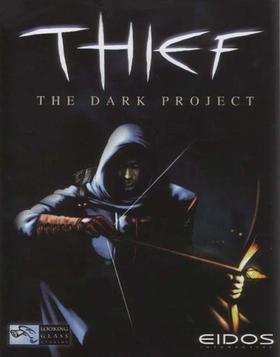
As for my choice to play a rogue, that credit must be given to my connection with my father and what we share. I grew up with video games, and my father and I often played video games together. One we enjoyed trading off was Thief: The Dark Project, a game that received great recognition for being the first first-person-sneaker in a market full of first-person-shooters. Unlike other shoot-em-up games in which the gamer often raced into a situation and consumed as many bullets as possible, Thief: The Dark Project required thought and planning for each situation, and often puzzle solving skills. Occasionally when playing my rogue, I remember this game and miss many aspects of it, wishing that Blizzard, Warcraft's creators, could make their rogues less reliant on magic and more on cunning as Eidos did with Thief. And of course, I always think of my dad.
Other avatars:
And to reference South Park again from above, here's the avatar you see every time you stop by my blog. I liked this one because it was very customizable. I do keep my hair in a ponytail. I don't have a biohazard shirt, but I'd wear one all the time if I did. I also love working on my computer, although mine is a mac laptop, and I listen to music very often and have an mp3 player, although I play my mp3 player in my car and rarely use earbuds. I guess my avatar is a lie, after all.
There are several sites out there to create a South Park "you," though I can't seem to find the one I used to make this one that has both the biohazard symbol for the shirt and the office background. If you happen to discover it, I'll happily bump the link up here.
This one, another highly customizable one, was created for and hosted by Yahoo! Messenger. I barely use it, but I like that I'm holding a book.
Yahoo! seems doggedly focused on the teenage group for their services. There are no body types except the basic one seen here, and a majority of the "accessories" are very brand oriented.
This was an original piece from my artistically inclined best friend. It's one of my favorites, and I can't help but feel honored by it. Of all my avatars, it's my only truly unique one.
That critter in the corner there is a monkey, and the picture is accurate: I can never seem to get my ideas down fast/clear/well enough.
There's no overt effort toward identity in any of my avatar choices, not even when I'm playing Warcraft. Identity happens. It's not something to spend time on, nor is it something to avoid. It's nothing to be scared of, and it's not worth second guessing for phantoms. It just is. Take avatars for what they are—a virtual image—and enjoy yours for the same reason.
This started out as a comment on Summertime's post about science fiction, fantasy, and the definition of art, and I ended up going a little long for just a comment, so I made it into a blog. This project is supposed to be rhizomatic in it's own way, too, so I hope this is alright.
I think a good story (fantasy or not) is like good design: the design never calls attention to itself, but fulfills a duty to the content by either being subservient to it (as the right font does for book reading) or complementing it (as most modern magazine layouts do). All that "visual icing" in movies is what helps absorb us into their stories. It's an elaborate illusion which we choose to believe so that we can meet other people or visit other worlds. When it's done well, we forget that it's a camera trick or that we're watching a movie and we focus on the story—the content.
I guess I just can't see that kind of a difference between fantasy/sci-fi and mainstream films or even independent ones. To me, believability comes from character and plot development, not genre.
You could also make an argument from theories of communication. A message is not simply the barebones content but includes the medium, among other factors. If we look at The Lord of the Rings trilogy then we could say that J.R.R. Tolkien's message of loyalty, courage, and friendship could not have been told another way. If it were set in the Middle East rather than Middle Earth, it would be a different message. We could not take away the same meaning from the two, much less the same story. Even the movie and the books provide two different experiences for the story, and thereby two different ways for each receiver of the message to understand it's meaning.
So, in short, I agree with Summer that it's "someone else's vision" that we can appreciate. Copyright issues aside, each creation is art in it's own right.
Also, the division between people on what is considered "art" is as old as postmodernism (or older, I'm sure). One group believes in a distinct division between high and low culture. The other sees no division in terms of artistic and influential value.
From the American Heritage Dictionary (second set on dictionary.com)"
| art 1 (ärt) Pronunciation Key n.
|
A pox on the nay-sayers! Damnit, it's art!
I ended up going long replying to a comment of Sara's regarding the rhetoric of online educational adverts. WARNING: this one is going to get ugly.
These for-profit universities make me—so—mad!!! RAAAAAAGE!! &%*# &^%@#$ *& ^%$##!@ ^%!! ME SMASH!! ME SMASH!!!
GYAAAAAAAAAAAHHHH!!!!!!!
*I'm now bald from tearing my hair out . . . inhale . . . exhale . . . mount soapbox*
I studied these schools because, like so many, many people, I was seriously considering one when I was ready to come back to school. I'd heard some warnings from friends, but I didn't take it seriously until I saw it in the news myself: many of these "universities" have been raided by the FBI and the Federal Board of Education for fraudulent claims and abuses against students.
Sara discusses the rhetoric, and that very well. I want to discuss the psychology:
Their advertising isn't so weak. It's very directly focused on those individuals who have just hit or passed their "quarter life crisis"—that time of panic and depression that comes from realizing that life isn't lining up to the grandiose ideal you had in mind as a youth. The "believe it and achieve it" mantra becomes a guilty reminder of one's own perceived failings as finance and responsibility find their way into reality.
But soft! Here comes our fairy god-professor to wave his magic mouse and grant our fondest dreams. These for-profit organizations are a dark Disneyworld for adults, their pandering promises as true as Tinkerbell, and their financial failues as real as taxes. It's too good to be true, and common sense should help one recognize that. However, their target audience—the disappointed failures (though only in their own mind)—are so desperate to recover their lost sense of self-worth, they will eat it up. What better way to snare them than to say, "It's not your fault. It's the system. You aren't responsible. You're special."
The end result common among "graduated" students is a cruel double-whammy. Not only are they left jobless and no better off in their education than when they first enrolled, they now owe thousands and thousands of dollars in student loan debt, of which there is no way out from paying in full (see report, above).
I completely agree with those who say higher education as it stands needs serious change, but moving to the digital age is only one part of it, and even then it has two great battles to face: 1) ensuring the quality of education within new media and 2) defying the horrid reputation that for-profit companies are setting up for online education.
Wait . . . what's wrong with donuts and coffee?
Now I want a donut . . .The phrase "music is life" deserves so much more than I'm about to give in this blog.
Trip Down Memory Lane: Writing in the Real and Virtual World(s)
Posted by Rachel 久允If writing genre fiction isn't bad enough for you, I should also tell you that for a couple of years I also wrote fanfiction. In one of the copy right sites Dr. P. sent us, there's a small section on the subject, with a link leading to a FAQ page on fanfic, which includes this definition: "Fan Fiction (FanFic) is a genre of amateur creative expression that features characters from movies, TV shows, and popular culture in new situations or adventures." Have you ever fantasized about your favorite characters and imagined them choosing a different path or continuing on a certain story line, unexplored in the original medium? If you were to write that out, you would be writing fanfiction. (There's a whole slew of information on the subject, including its impact, good or bad, on the original author and the writing community, but as this is part of a memoir and not a research paper, I'll save that for another time.) One of the main outlets for my fanfiction addiction was fanfiction.net. (No, I will not tell you my user name so you can go read my miserable work!) Databases like this allowed readers to quickly find a certain category of fanfiction or author and even allowed users to search for stories with specific elements using the filter in the search engine.
![]() |
RP: short for role play or role playing (e.g., Dungeons and Dragons, Renaissance fairs, etc.)
MMOG: massively multi-player online game (e.g., Second Life)
MMORPG: massively multi-player online role playing game (e.g., Everquest, Star Wars Galaxies, etc.)
I admit, I'm addicted to World of Warcraft, as are several million people around the world. I also understand that addiction and know where it comes from. In December of 2006, the academic journal, Emotion and Motivation published a four part study of people who play MMOGs and the three key psychological aspects behind the behavior:
Identity. Because most MMOGs allow detailed character customization, a player can participate in making that character his or her very own. The choices the player makes affect that character, giving the player a sense of control and individualism in identifying with that character.
Goal setting and meeting. MMORPGs in particular are often filled with various quests and assignments that the player must choose and fulfill through his or her character if that character is to progress in level and skill. Some goals, like those of the recently implemented achievement system in World of Warcraft, offer no rewards which affect the character's abilities, playstyle, or in-game revenue, yet most players actively participate in them and compete with one another in a race to complete them.
Community. Massively multi-player online games are just that: games in which hundreds of players have the opportunity, and often, the necessity to interact with one another, choosing to become enemies or comrades, competitors or partners. Social networks are solidified through the creation of guilds, in which players who share common goals (and similar play times) can more easily interact with each other to help the guild as a whole. By grouping with others, players not only are able to achieve more of their goals in the game, but they have the opportunity to socialize through text (chat).
A large portion of the MMORPG community is comprised of RPers. When someone RPs in a game, he or she does not freely chat about classes, celebrities, or the score on a recent sports event while performing the game's quests. An RPer immerses his- or herself in the game, approaching the character as an actor does. The joy of RPing is the ability to loose one's self for a while into a world that is so different from ours and exist in a fantasy we only find in books and movies: honor, etiquette, romance, and war.
However, I do not role play.
As a writer, I'm fascinated by it. Here are hundreds of people getting together in a similar environment to create histories, stories, and motivations and work them into the game's universe. That's no small feat! However (also as a writer), I'm puzzled by the lack of collaboration between players. I've collaborated with others on several stories and a couple of screenplays. When you're with a partner who clicks with your personality, the results are inspired and exciting. A full community of computer-mediated actors should find themselves at least improvising an interesting thread of new story. Yet more interaction is spent on correcting other players' misalignments from the miniscule segments of the game's lore than on developing and nurturing good ideas. In fact, the development of a full story line is made unimportant, if not impossible, by the structure of the game itself. Every RPer has a back story for his or her character, but unless the current motivation is driving the character to kill the game's world boss King Fancypants, the story has no arc and no conclusion—and even if the character does land the killing blow on that fearsome foe, Fancypants will just respawn (reappear) for that character to fight again next time. Damn reincarnations . . .
Perhaps if I could reasonably work in a believable explanation for the existence of a Fancypants clone factory, I might be more inclined to give RPing another try. Until then I'll continue to incorporate the real world into my chat and save my imaginings for an open white sheet.
As I'm trying to decide exactly what I'll write my memoir about, I've remembered a few things we never mentioned in class. Because I'm still digesting the subject matter, and because I love feedback, I thought I'd share my brainstorms here.
VHS cassettes
As a kid, I had a full library of bubbly, oversized plastic cases of these as well as a number of paper sleeved cassettes labeled with my mother's ornate calligraphy. I wore the ribbon down on a few of my favorites, and we had to rerecord them.
I remember hearing about DVDs when they first came out and being less than enthused about them. It would be great to have a permanent copy of my movies and specials, but the price was just too high for anyone middle class to afford the players.
Now, a decade and a half later, I not only keep a DVD player exclusively, I also record and edit my own movies on my laptop. My only lament in losing a VHS player is losing some of the movies I loved back then. Although many classic movies and television shows have been reproduced on DVD, most of the ones I watched did not.
Fisher Price plastic turntable
I'll let this video explain that one to you. :)
Game & Watch: Mario's Cement Factory
My first handheld game. It was a single screen LCD with a few simple buttons that allowed you to reposition an inksplatter version of Mario (I would hardly call it "move") to each side of the screen to release the cement to the lower level before the stacks got too full. I don't remember exactly what happened if the containers did get too full—aside from losing—but the game itself did teach me time management under pressure. Maybe this is one reason I tend to wait until the last minute to do everything: stress under a clock. Who would have thought that gaming taught me to be so self-destructive?
flow chart stencil
When I was younger, my dad was a programmer who always began his work with pencil and paper. Before he'd even type line zero, he'd draw elaborate diagrams of processes: input, decisions, executions. He'd label everything in the rigid, legible print that carried over into his everyday handwriting, and then he'd explain to me, even as I could not understand then, what each geometric shape meant and how to follow the line that connected them all. When he bought a new stencil for himself, he gave me his old one.The type of flow chart this tool was designed to create is considered out of date now, replaced by a nesting box design; however, I find the latter more confusing. The uncluttered structure of my father's practice seems comforting in its clarity.


