The trouble with stereotypes is that there is always some hidden truth in them, whether past or present. Every time we see a stereotype acted out, whether through media or in reality, the stereotype is reinforced in our minds, even if we don't want to believe or admit it. That's why they're so hard to shake off. And now, with the technological advances of the 21st century we have more stereotypes and more ways to reinforce them.
The particular stereotype I'm concerned with here is that of the avatar. It's no new fad that people would love to unmask the anime-ish, scantily clad sex kitten to reveal an obese 34-year-old playing at his computer in his mother's basement. It's become such a common expectation that it's cliché, and one that South Park happily used in their gaming episode, "Make Love, Not Warcraft" (embed disabled; the avatar is confronted and revealed between 2:25-2:40, enjoy).
To help combat this blatantly unfounded misconception, I'm dedicating this blog to my own avatars, with explanations for their appearances.
 This is Link from the game The Legend of Zelda on the Nintendo Entertainment System. I didn't choose anything about him, but he was my connection—my link—into another world, Hyrule, and during my adventures there, I changed him dramatically, so that he was more powerful at the end of the game than at the beginning.
You might argue that he cannot be my avatar because he is not unique to me, and I'm not using him in a multi-user interface. However, uniqueness is not a requirement for avatars. Many forums or comment sections of articles have a pre-set selection of images to choose from and nearly all will assign a default image to occupy your avatar space until you replace it with one of your own. There is also no necessity for a multi-user space. The term avatar is borrowed from Hindu mythology and is the incarnation of a deity in human or animal form. Within a game such as The Legend of Zelda, I am a god: the most powerful force within that particular universe with the ability to change the world through my actions.
 This is Shadowless, my Blood Elf rogue from the World of Warcraft (in admittedly old gear; I have no recent screencaps of her since I quit playing). If you were to judge by the measure of the stereotype, you would say that I made her blonde because I'm a brunette, I picked a Blood Elf because they're waifs and I'm 140 pounds, and I picked a rogue because darkness is supposed to be sexy and I secretly have a violent streak appropriate for assassination. You would be half-wrong on all counts. (I told you stereotypes have a hint of truth.)
I made her blonde because dark hair is the most popular choice for rogues in the game, and while World of Warcraft only has a limited number of choices for a character's look, I wanted to make some effort toward uniqueness. For that same reason, I kept her hair bobbed short; everyone else seemed to be making female hairdos long, elaborate, and with plenty of frou frou. I chose the Blood Elf because, at the time, they were a recent addition to the game, and I was looking forward to trying something new. My choice before Shadowless was the less popular female Tauren (Blizzard's version of the minotaur). There's nothing "runway model" about an 8-foot-tall cow wielding a massive fire-imbued mace as large as herself.
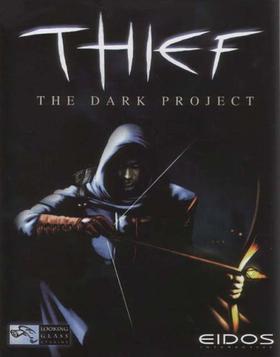 As for my choice to play a rogue, that credit must be given to my connection with my father and what we share. I grew up with video games, and my father and I often played video games together. One we enjoyed trading off was Thief: The Dark Project, a game that received great recognition for being the first first-person-sneaker in a market full of first-person-shooters. Unlike other shoot-em-up games in which the gamer often raced into a situation and consumed as many bullets as possible, Thief: The Dark Project required thought and planning for each situation, and often puzzle solving skills. Occasionally when playing my rogue, I remember this game and miss many aspects of it, wishing that Blizzard, Warcraft's creators, could make their rogues less reliant on magic and more on cunning as Eidos did with Thief. And of course, I always think of my dad.
Other avatars:
 And to reference South Park again from above, here's the avatar you see every time you stop by my blog. I liked this one because it was very customizable. I do keep my hair in a ponytail. I don't have a biohazard shirt, but I'd wear one all the time if I did. I also love working on my computer, although mine is a mac laptop, and I listen to music very often and have an mp3 player, although I play my mp3 player in my car and rarely use earbuds. I guess my avatar is a lie, after all.
There are several sites out there to create a South Park "you," though I can't seem to find the one I used to make this one that has both the biohazard symbol for the shirt and the office background. If you happen to discover it, I'll happily bump the link up here.
 This one, another highly customizable one, was created for and hosted by Yahoo! Messenger. I barely use it, but I like that I'm holding a book.
Yahoo! seems doggedly focused on the teenage group for their services. There are no body types except the basic one seen here, and a majority of the "accessories" are very brand oriented.
 This was an original piece from my artistically inclined best friend. It's one of my favorites, and I can't help but feel honored by it. Of all my avatars, it's my only truly unique one.
That critter in the corner there is a monkey, and the picture is accurate: I can never seem to get my ideas down fast/clear/well enough.
There's no overt effort toward identity in any of my avatar choices, not even when I'm playing Warcraft. Identity happens. It's not something to spend time on, nor is it something to avoid. It's nothing to be scared of, and it's not worth second guessing for phantoms. It just is. Take avatars for what they are—a virtual image—and enjoy yours for the same reason.


1 comments:
Long live The Legend of Zelda!
Post a Comment